
I wrote this piece a week after October 7, 2023. I had no idea about the genocide that was about to be unleashed.
I’m sharing it today, because May 14th is the birthday of Israel. And May 15th is Nakba Day. The catastrophe that hasn’t eased for 78 years.
I hope my words bring some clarity.
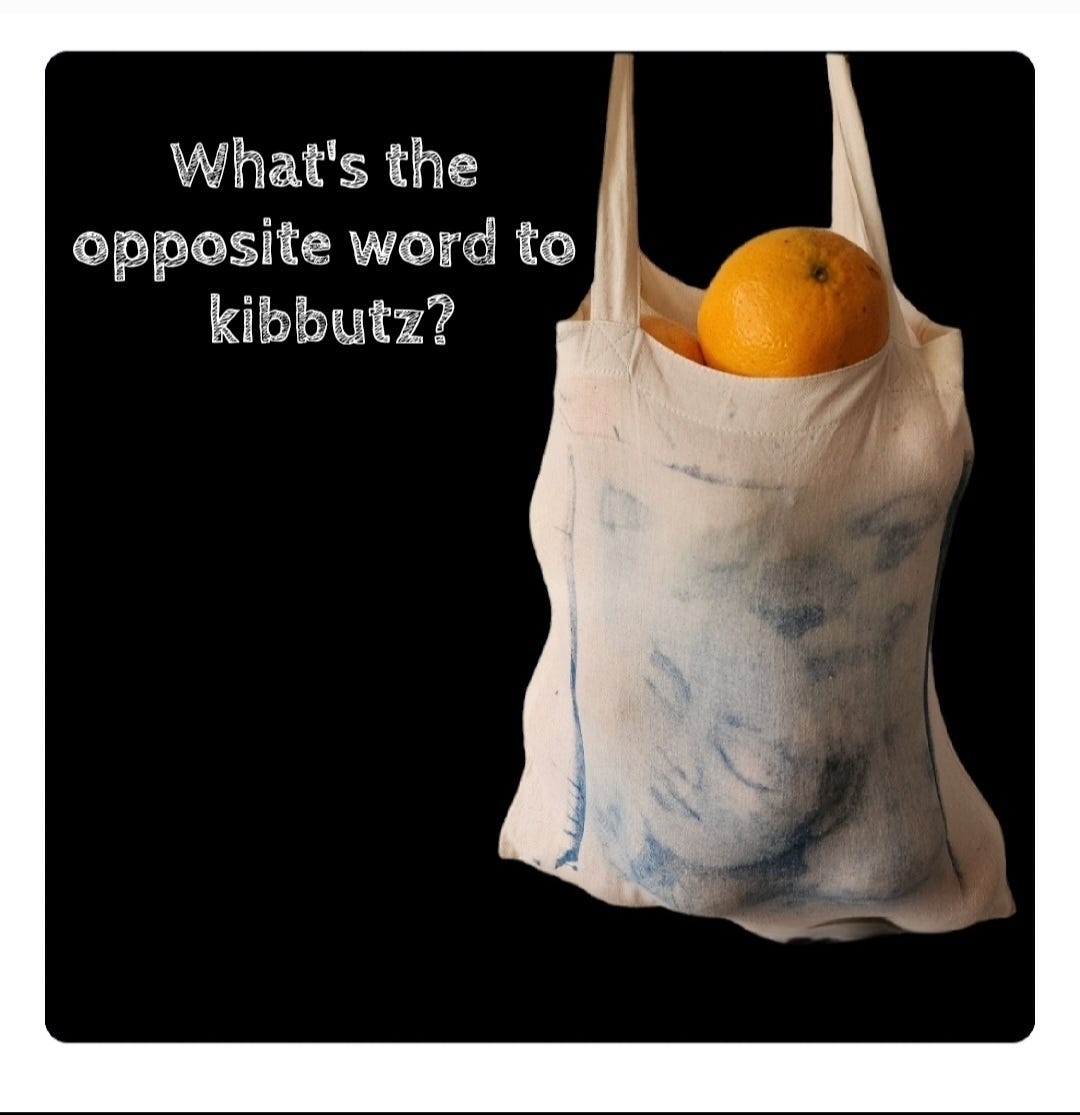
Almost every time I mention that I grew up in Israel the first response is,
“Oh did you live on a kibbutz?”
It’s as if the word ‘Israel’ triggers a reflex in people that either leads them to tell me about one of their relatives that spent time on a kibbutz, or how they had always wished they could have experienced it themselves, but life got in the way.
I’m guessing that spending time picking oranges in sun drenched orchards and driving tractors while wearing a singlet, was pretty much every Generation X’s ultimate dream after finishing school.
It’s an image of Israel that carries with it a strong sense of nostalgia and taps into a deep yearning to be part of something new and exciting, belonging to a community with a common goal while meeting travelers from around the globe.
It’s a beautiful image of a young country building itself up after a horrific chapter in Jewish history.
This past week, the word kibbutz has been shrouded in the most horrific images possible. Bodies wrapped in plastic, lined up on lawns. Walls splattered with blood and bullet shells in amongst scattered toys. As I write this there is still no word about my friend’s eighteen year old son, who was abducted from his safety room in their kibbutz.
It’s an absolute nightmare. Worse than we could ever have imagined.
Here’s the thing though, there’s another Hebrew word that we need to become just as familiar with as ‘kibbutz’. It’s a word that we need to remember as we are bombarded with footage and headlines from Israel, the land that boasts to be the only democracy in the Middle East.
The word is ‘kibbush’, and yes, it sounds bizarrely similar to the word ‘kibbutz’.
Kibbush means occupation, and in the context of Israel it couldn’t be further from the images that picking oranges in sun drenched orchards and driving tractors while wearing a singlet conjure up.
Occupation is the opposite of community coming together. In fact, occupation is about systematically trampling down a people group who are going through an extended horrific chapter in their story. Occupation means withholding clean water and electricity from parents and their children. It means driving families out of their homes and telling them they have no right to return. Occupation means shooting at civilians when they hold peaceful protests. Occupation means populating Palestinian land that has been lived on for generations with new settlements brimming with extremist American Jews, who then burn ancient olive groves and fill water wells with cement.
This past week I have been accused of being too sympathetic towards Palestinians. That as an Israeli citizen I need to honour our people and defend our land. Surely I haven’t forgotten the Holocaust and what happened to millions of Jews?
Truth is, as much as the Jewish people suffered and were victims to a horrific genocide; we don’t have a monopoly on pain and trauma.
I’m going to write that again.
Jews don’t have a monopoly on pain and trauma.
And if anything, it’s because our story is filled with unjustified violence and racism, that we should be the first to speak up against it. Not to turn a blind eye, especially when it’s the Israeli government who is inflicting the terror.
Apparently this view makes me “a dreamer” who lives in a fairytale. A peacenik. A self hating Jew. And the favourite slur, a Kapo. These were the Jews in the Holocaust who helped the Nazis in the concentration camps. Apparently that’s who I am, by speaking out for the oppressed.
What those that accuse me of having a simplistic mindset don’t realise is, that it’s not that long ago that I was one of them. I used to think that us Jews were the victims and that “Arabs” were the perpetrators. That was a childhood “truth” that I never ever questioned. But surely living in a fairy tale should be said of those that still hold on to the story they were told as a child? A story with goodies and baddies. A story of ‘us’ versus ‘them’. A story where we are in the right, and they are in the wrong. That’s a story suited for those in kindergarten. I on the other hand have had to step away from the story I was told as a child, and look at it with fresh eyes.
For me that meant stripping away the political narrative that blames Palestinians before I even gave the other person a chance to share their story. And then use critical thinking to see what is actually happening right now on my watch.
It hasn’t been easy, and it has meant facing some very harsh truths about the narrative I inherited, and actively supported.
Like everyone else I long to belong to a greater cause. I too want to feel that community spirit of working together for the greater good. For me it’s not going to happen while picking oranges on a kibbutz though. For me, it’s happening here in Melbourne suburbia. As I start my own quest of opening up people’s eyes to the ‘kibbush’ taking place right now. And how we all need to use our circles of influence to make sure that as the eyes of the world consume the horrible news coming from Israel and Palestine, we can speak for those whose voices have been choked for nearly eighty years, whose basic human rights have been stripped away for generations, and whose homes have been passed on to strangers to live in, and whose children were born into captivity.
That’s such a powerful story especially given the time you wrote it. As a Gen Xer I too grew up with romanticised stories of the Israeli Kibbutz. Clearly this vision was pushed as part of the Zionist propaganda narrative of « a land without people for a people without a land ». At the time Israel became synonymous with the socialist ideal of community farms.
It makes you realise the extent to which Israel has totally destroyed its carefully constructed image of a just, fair and equal society. Clearly Zionists do not believe they need that image any more particularly given what they need to do in order to achieve their dream of a greater Israel.
I have never heard the word kibbush, certainly I have heard the stories of ‘amazing time on a kibbutz, connecting with community and land’. Thank you for sharing - your resolve to keep speaking, keeps me going ✊🏽🇵🇸 x